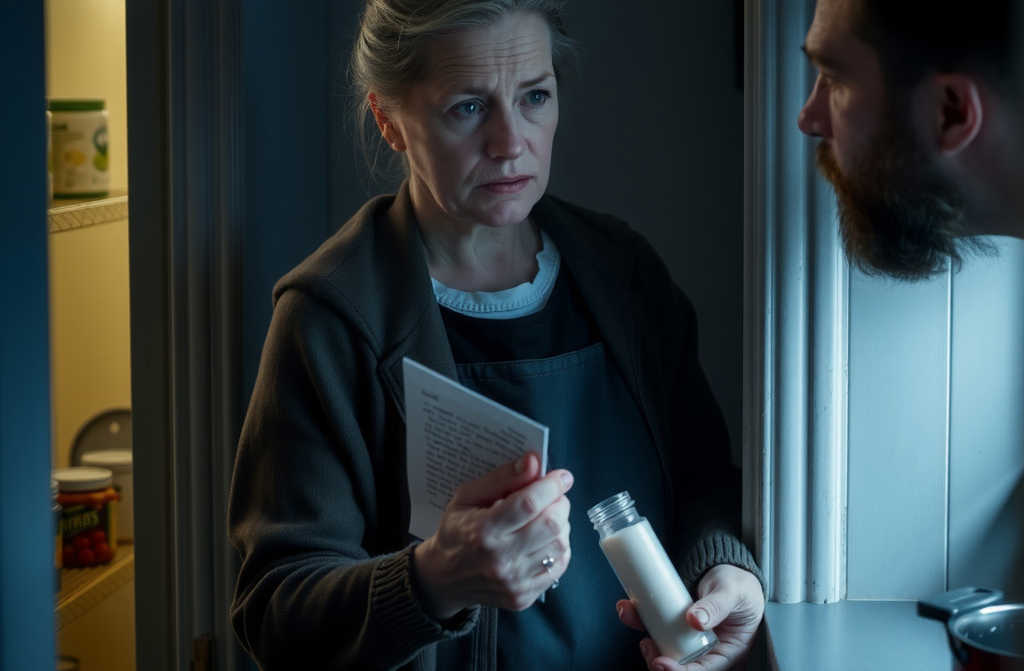
Emily slipped behind the pantry door a heartbeat before the bolt clicked shut. She pressed her back against the shelf of tins, feeling for the inner knob and pulled it just enough to leave a sliver no wider than a finger. Her breathing was ragged, a harsh rasp, and she pressed her palm over her mouthany sound would echo through the silent hallway and rip the fragile calm of the flat.
The front door burst open.
James cleared his throat, stepped into the entryway. Through the narrow gap Emily saw his hands: two white grocery bags bulging with produce, the ropehandles digging into his fingers.
Mum! he called. Are you home?
Emily tightened her grip around her palm.
***
Emily had been alone for five years before all this began. When Kolyanow Jamessuddenly vanished, as so often happens to those who hide their pain, his heart gave out and everything fell apart.
The first year without him was the hardest: it wasnt the grief itself that broke hershe could endure thatbut the silence in the flat gnawed at her edges. James used to laugh at the TV so loudly that every joke seemed to vibrate the kitchen walls. In the bathroom he sang blasphemously, mangling both lyrics and melody without a hint of shame. Now, with the bathroom door forever shut, the only sound was the low hum of the pipe, a noise that seemed deafening to Emily.
Their daughter, Grace, rode the train from Sheffield in the first few days. She stayed two weekscleaning, cooking, sleeping on her mothers bed at nightsimply being there, without demanding conversation. That was priceless.
Tom, however, never turned up, neither then nor later. It had been eleven years since he disappeared, and Emily had long since stopped explaining the why aloud, though inside she replayed the story over and over like a scratched record.
Toms departure was painful and tangled, the sort of truth that stays under the rug for far too long. He had been a difficult child: sharptempered, prone to tantrums over the slightest thing. He barely scraped through school, repeating a year in Year 6 and graduating with a string of Cs. His sister Grace, by contrast, was the epitome of calm and studiousness, bringing home straight As.
Tom resented Grace, snapped at any rebuke, and James sometimes lost his temper, though he tried desperately to hold back.
When Tom turned nineteen, James sent him to spend the summer with his mother, the formidable Mrs. Clarke, in a tiny village outside Rye. He thought the country air and hard work would straighten him out.
Mrs. Clarke was blunt to a fault, never one to mince words. When Tom botched the garden, she snapped, What did you expect, you useless lad?
Tom was back in London that very day. He dropped his bag in the hall, shuffled to the kitchen, sat down and asked, voice flat, Is it true?
Emily stared at James. James met her gaze.
They had been planning to tell him himself for ages, always postponing, each convincing the other that the time wasnt right, that hed still have a bit more growing to do.
Its true, Emily said. We took you in when you were eight months old. You screamed so loudly the whole ward shook, but the moment you saw us you fell silent and stared at me.
I told James then, Its our son, theres nowhere else for him to be.
Tom stood and slipped into his room. Emily and James lingered in the kitchen until midnight, talking about everything except that, because they didnt know how to speak of it.
A few days later Tom vanished again, taking the money Emily and James had been saving for his student flata surprise theyd planned for the autumn. He staged his own surprise first.
James rarely mentioned him out loud. In the evenings hed sit by the window, watching the street.
Emily saw his pain, but she didnt pry. James dealt with his grief in silence, and she respected that. A few years later his heart gave way as well.
Tom reappeared at the start of April. He knocked gentlyno bell, just a tentative rapas if he wasnt sure anyone would answer.
Emily opened the door and froze, staring at a thirtyyearold man with a rough beard, slightly hunched, cradling a bag of mandarins.
Mum, he said, voice trembling. Im sorry. I was foolish back then.
She stood, unsure what to do with herself.
I want to make amends, he added. If youll give me a chance.
She pulled him into an awkward hug at the doorstep. He returned it clumsily, as if hed forgotten how an embrace worked after years of none.
At dinner he talked about his work as a chef, travelling the country from Brighton to Newcastle, starting in cheap canteens and eventually cooking in upscale restaurants. He really could cook.
Emily watched him deftly carve a chicken, thinking how oddly life works: a man disappears for eleven years and then returns to fry you a mince pie.
He stayed. He reclaimed his old room, lined the shelves with his stuff, and each morning made porridge or scrambled eggs. Emily called Grace every night.
Did he really come back? Grace whispered on the other end. Hows he holding up?
Fine. Polite. Cooks a dab hand.
Mum, are you sure everythings alright? Eleven years is a long time.
Grace, hes my son. Dont act like a stranger.
She phoned relatives across the country, telling everyone: Toms back, Toms home. A cousin in Manchester sniffed into the phone, muttering that theres no smoke without fire and people dont just stroll back from the brink.
Emily replied that no one needed to gossip; everything was fine.
About two weeks later Emily began feeling exhausted far more than before. By evening her head felt padded with cotton; in the mornings she was dizzy. She chalked it up to springs changevitamin deficiency, bloodpressure swings, age. At sixty, health is a fickle thing, she thought, and there was nothing specific to complain about. The main thing was that her son was near.
Grace asked each night how she felt. Emily said she was okay, a little tired, but it would pass.
Maybe see a doctor? Grace suggested.
Dont be daft, Emily snapped. I wont be running to the GP for every little tiredness. You wait two weeks for an appointment; itll sort itself.
It didnt. Nausea grew, her head felt heavy by lunch.
Emily took vitamins, brewed rosehip tea, tried not to spiral.
That night she woke before six, the April sky a dull grey, the street empty. Her mouth was parched; she swallowed hard, slipped on slippers, and padded to the kitchen for water. The hallway lights were off; she knew the flat by heart, every turn.
She stopped short of the kitchen.
Tom stood at the stove, a single burner alight beneath a pot of porridge. He held a small plastic sachet, tipped its contentsa powderinto the pot, then stirred with a spoon.
Emily retreated down the corridor, slipped into the bedroom, pulled the covers over herself, and stared at the ceiling with eyes wide open. Minutes later the bedroom door creaked.
She squeezed her eyes shut, breathing evenly, pretending to sleep. She felt Toms gaze through the doorway. He lingered, then closed the door.
The front door slammed.
Emily opened her eyes. Dawn was breaking. She lay there, counting dates in her mind: when the nausea began, when the heaviness settled, when the leaden fatigue arrived. It all lined up exactly with the day Tom moved back and took over the cooking.
She rose, dressed, and decided to visit her neighbour, Mrs. Thatcher, on the third floora sensible woman who didnt beat around the bush and could handle a crisis without tears. Emily was pulling her coat over her shoulders when the lock clicked.
She never realized shed been pulled back into the pantry.
Through the slit she watched Tom pull out his phone and press it to his ear.
Hello? Yeah, Im home. He paused. No, the old ladys gone missing, shes nowhere to be found. He paced the corridor. Dont get worked up, he muttered. Im almost done here, just a few more minutes.
Her time was running out. She thought maybe it was just a vitamin thing or blood pressure. He snorted, Well clear the flat quick, its not a big job, and Ill be with you straight away. Well survive!
Emily stood frozen, palm over her mouth, watching her son through the crack.
Bloody hell, I forgot the chemist again, Tom muttered irritatedly. Ill have to pop out again. He cursed. Fine, Ill be back soon, just wait.
The door slammed. Footsteps faded on the stairs.
Emily emerged from the pantry and stood in the hallway, eyes lingering on his coat hanging on the peg, his boots by the door, the spare key on the shelf. The lower lock was only on her key; she hadnt given a spare to anyone.
She packed her bag in twenty minutes: papers, her pension booklet, a small photograph of James in a frame.
She phoned Grace.
Mum, why are you up so early? Grace yawned into the receiver.
Im thinking, love. Ill come over to you.
Come on then. When?
Today.
Today?! Grace sat up, startled. And Tom? He should come too, I want to see my brother.
Hes off working, not around. Ill be alone.
Fine, just send me the train details, Ill meet you.
Emily hung up, tucked Toms belongingsseveral shirts, a shaving razor, a battered bookinto his bag and zipped it up. She placed the bag on the landing by the front door.
She took a scrap of paper and a pen, wrote slowly, clearly:
Tom. I love you, have always loved you, and will always love you, even if you dont deserve it. Thats why I wont go to the police. But I never want to see you again. Never. Mother.
She slipped the note atop the bag, closed the door on the lower lock with her own key, and slipped it into her coat pocket.
She caught a bus to Vauxhall station, rode the Tube to Waterloo, boarded a train for the north, changed at Kings Cross, and rode the empty platform at a quiet station. She bought a ticket to Sheffield on the daytime service, found a seat in the waiting room, and watched a man toss breadcrumbs to a flock of pigeons.
The birds pecked and fluttered.
Emily sat, thinking she would have to tell Grace the whole story eventuallynot now, not at the doorstep, but eventually. Grace was smart; shed understand and not wail pointlessly.
She tried not to think about Tom at all; that was impossible.
Grace met her on the Sheffield platform, ran the short distance and embraced her tightly, before any words could form. Emily leaned into her daughters shoulder and closed her eyes.
Mum, Grace whispered, what happened?
Ill tell you later, Emily replied. Lets get home first.
They walked together along the platform, Grace carrying her bag, the weak morning sun spilling over them.
Emily walked, imagining the pantry in London, the top shelf holding a jar of cherry jam saved from a summer long past, never opened. She smiled at the thought. Happiness isnt in a jar of jamShe watched the train pull away, the platform receding into a blur of steel and sky, and felt a strange calm settle over her chest. The world outside the window was a patchwork of clouds and fields, but inside her mind the kitchen, the pot of porridge, and Toms low mutterings swirled together like a storm she could no longer ignore.
When the train finally shuddered to a halt at her hometown, she stepped onto the platform with a single purpose. The citys familiar streets seemed thinner, as if the weight of the past had been peeled away, leaving only the bare bones of what remained. She bought a singleuse ticket back to London, the number on the pamphlet matching the address she knew like the lines on her own palm.
The journey home was quiet, the hum of the carriage a soft lullaby that let her thoughts drift. She rehearsed the words she would say, the exact phrasing of the letter she had left in the bag, the way her hands would tremble when she finally placed it on the kitchen table. She imagined Toms facehard, unyielding, yet somehow hauntedand the flicker of recognition that would pass through his eyes when he saw the truth she had finally gathered.
The tube emerged from the tunnel and rolled into the familiar station, the lights of the platform reflecting off the wet pavement. Emily took a deep breath, feeling the cold air fill her lungs, and stepped onto the train that would deliver her back to the flat that had become a tomb of secrets.
When the doors hissed open at the station, she walked straight up the stairs, her steps echoing in the empty corridor. The flat was still dark, the curtains drawn, a thin veil of night clinging to the windows. She slipped the key from her pocket, turned it, and pushed the door open with a soft click that sounded louder than any alarm.
Inside, the kitchen was exactly as she remembered: the kettle perched on the stove, a single mug waiting on the counter, the window halfajar and letting in the faint scent of rain. A faint hissing sound rose from the back where the pantry door was ajar, a sliver of light slicing through the darkness.
Emily moved silently, the familiar smell of boiled potatoes and stale bread filling her nostrils. She followed the sound to the pantry, the narrow gap still left between the door and the wall. In the dim glow, she could see Tom hunched over the small table, a bottle of white powder in his hand, his face illuminated by the weak lamp of his phone.
He turned at the sound of her footfall, his eyes widening for a fraction of a second before the practiced mask settled back in place. Mum, he said, voice flat, youve come back.
She didnt speak. Instead, she placed the folded note on the countertop, the paper trembling slightly as she set it down. Read it, she whispered, the words barely more than a breath.
Tom stared at the paper, his jaw tightening. He unfolded it slowly, his eyes scanning each line. When he reached the last sentence, the room seemed to hold its breath. You you were planning to go to the police? he asked, a tremor of panic creeping into his tone.
Emily stepped forward, her hands clasped at her sides. I never wanted to hurt you, she said, but you made me sickliterally. You thought you could control me, keep me here with with that powder. Ive lived long enough to know enough about poison. Ive called the doctor. The test results are already on their way. Theyll know exactly what youve been putting in my food.
Toms shoulders slumped, the composure cracking. I didnt I thought I thought if I made you weak youd stay. I was scared youd leave, that Id be alone again.
A soft chuckle escaped Emilys throat, not of humor but of relief. You tried to bind me with a toxin, Tom. You thought love could be forged in a syringe. The truth is, love isnt a cage. Its a choice, and the only choice you gave me was to leave.
She turned away, her eyes already on the hallway. Im going to the hospital, and Im going to call the police. Im going to make sure they understand exactly what you did. And after that, youll have to answer for the years you disappeared, the money you stole, the lives you broke.
Tom watched her go, his face a mask of regret and desperation. He reached for the bottle, then stopped, his fingers trembling. He let it fall to the floor with a soft clatter, the white powder scattering like snow across the tiles.
Emily walked out of the flat, the door closing behind her with a definitive click. The night air hit her cheeks, sharp and cleansing. The city lights glimmered like distant stars, each one a promise of new beginnings. She hailed a cab and gave the driver the address of the hospital, her voice steady.
At the hospital, the doctor confirmed the presence of a rare sedative in her bloodstream, a substance that, if left unchecked, could have slipped her into a coma. The doctors administered an antidote, and Emily felt the fog lift from her mind. She sat up, the world coming into focus, the rush of gratitude overwhelming her.
Later, in a small interview room, a uniformed officer took her statement. As she recounted the events, she felt a strange peace settle over hera sense that the pantrys darkness was finally being illuminated, that the secrets that had haunted her for decades were finally surfacing.
When she stepped out of the police station, the sky was bright, the sunrise painting the clouds in shades of gold. She saw Grace waiting on the curb, a smile blooming across her face. They embraced, the years of fear and silence melting away in that simple, fierce hug.
Lets go home, Grace whispered, her voice warm.
Emily nodded, looking back at the city she had once fled. The flat still stood, its windows dark, but the story that had unfolded within its walls was no longer hers to bear alone. She turned toward the waiting train, the rhythm of the tracks echoing the steady beat of her own heartsteady, resilient, and finally free.


